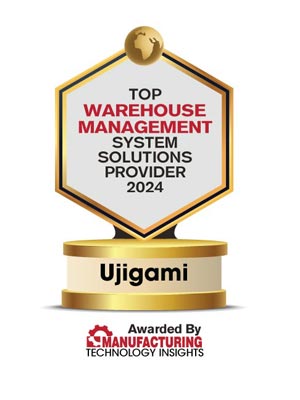
Ujigami | Top Warehouse Management System Solutions Provider 2024

Ujigami
Offering Transformative Warehouse Management Solutions

Share this Article:

Edward Dickson, Ujigami | Manufacturing Tech Insights | Top Warehouse Management System Solutions ProvidersEdward Dickson, President
The world of digital commerce has been transforming at lightning pace. Novel technologies and process trends have always pushed the envelope. However, the role of well-oiled warehouse management machinery has always been crucial for businesses to thrive.

And that’s where the real problem lies. The world of warehouse management is riddled with diverse and pressing challenges.

On the one hand, businesses are struggling to keep pace with real-time demands due to outdated systems. On the other hand, they need dynamic inventory management to operate in ever-changing market environments. As a result, businesses are required to leverage innovative solutions to enhance their warehouse management practices.

By offering transformative solutions, Ujigami is revolutionizing the warehouse management paradigm.

One of the primary pain points plaguing warehouse management systems today is the reliance on ERP/MRP systems ill-suited for the dynamic nature of modern warehouses. Unlike traditional batch-based systems, Ujigami operates in real-time, providing instantaneous updates and adjustments to meet the evolving demands of the warehouse floor.

“With the constantly changing material requirements, Ujigami can instantly adapt, reallocating resources, and directing personnel and other resources with unparalleled precision,” says Edward Dickson, the president of Ujigami.

Consider the scenario of picking kits for shipment or assembly. In a conventional ERP/WMS environment, an empty stock location may lead to inefficiencies and delays if subsequent picks are directed to the same location. Ujigami’s system immediately triggers alternative actions as soon as an operator encounters an empty location. It directs the operator to backup stock locations while simultaneously initiating restocking tasks to replenish the empty location, enabling uninterrupted workflow and optimal resource utilization.

Ujigami’s ability to conduct cycle counts while the warehouse is in operation represents a quantum leap in inventory management efficiency. Unlike batch-based systems that require a freeze on all movement during counting, Ujigami seamlessly integrates cycle counts into ongoing operations. As parts move from one location to another, it automatically updates count expectations, ensuring accuracy without workflow disruption. This capability streamlines inventory management and enhances overall warehouse productivity.

For example, one of Ujigami’s Midwest distributor clients needed to keep pace with the demands of their growing business while maximizing warehouse throughput. However, with limited space and escalating turnover rates, the distributor could not keep up with the needed capacity. With Ujigami’s innovative warehouse management solution, the distributor achieved unprecedented levels of efficiency and productivity in a very short period.


With the constantly changing material requirements, Ujigami can instantly adapt, reallocating resources, and directing personnel and other resources with unparalleled precision

The distributor experienced a staggering 40 percent increase in output. This achievement was made possible by Ujigami’s ability to ensure that the right parts were in the right pick locations at the right time, including dynamically allocating locations to current demand. Leveraging advanced AI-driven technologies, Ujigami orchestrated the movement of materials with precision. The company’s MCS solution also directly controls automated guided vehicles (AGVs), carousels, and pick stations.

Ujigami’s success story exemplifies the transformative impact it has had on numerous clients. Central to this success is the company’s adeptness at leveraging the latest technological advancements and automation processes. By doing so, Ujigami remains at the forefront of enabling businesses to survive and thrive in today’s highly competitive landscape.

Ujigami enables warehouses to operate efficiently and with agility. As the demands of the industry continue to evolve, the company will keep on functioning with its aim to build the future of warehouse management. The ultimate goal is to combine and deliver efficiency, accuracy, and adaptability in a seamless manner. With Ujigami leading the way, the warehouse of tomorrow is not just a vision but a tangible reality.
Deep Dive

Restoring Control in Manufacturing Execution Systems

Manufacturing execution systems have drifted from their original purpose. What began as a layer responsible for coordinating production, controlling processes and reporting outcomes has, in many environments, narrowed into a passive data collector. Reporting has migrated toward specialized business intelligence platforms, leaving many execution systems detached from the real-time decisions that determine throughput, quality and consistency on the plant floor. For executives evaluating modern manufacturing execution software, the central question is no longer how well a system captures data, but whether it can actively govern production as it unfolds. Effective systems distinguish themselves by their ability to coordinate machines, operators and process logic within a single, continuously responsive framework. Production environments operate at a level of variability that static scheduling or post-process reporting cannot address. Each unit may require different parameters, instructions or routing decisions depending on configuration, demand or upstream conditions. Systems that translate process plans into executable, unit-level instructions, then dynamically adjust equipment settings or routing decisions in real time, create a level of control that aligns output with specification without slowing throughput. Traceability remains a non-negotiable requirement, though its value depends on how it is generated. Static logs or batch-level records fall short when manufacturers need a complete, unit-level understanding of how a product was built. A more advanced approach captures every interaction between machine, operator and process condition, linking it to a single production instance. This produces a continuous record that reflects not only what was done, but whether each step met defined specifications before the product progressed. Such traceability strengthens compliance, reduces rework and supports faster root-cause analysis without introducing friction into the workflow. " Ujigami’s digital instruction framework ensures that operators receive precise, unit-specific guidance in their preferred language, improving clarity and consistency across the workforce. " Operator coordination has emerged as another defining factor. Labor constraints and multilingual workforces introduce complexity that traditional systems rarely address. Systems that deliver step-specific, context-aware instructions tailored to each unit, combined with automatic language adaptation based on operator profiles, reduce ambiguity and training dependency. This ensures that execution quality does not vary with experience levels or language proficiency, preserving consistency across shifts and locations. The role of integration has also shifted. Rather than acting as a reporting hub, modern execution systems must function as a control layer that interfaces directly with equipment, enterprise systems and external analytics platforms. Data collection supports this role, though its primary purpose is to enable immediate validation and adjustment rather than retrospective analysis. Organizations increasingly prefer to pair such systems with independent analytics platforms, allowing reporting flexibility without compromising execution discipline. Ujigami reflects this transition by repositioning the execution system as an active controller of manufacturing processes. It connects directly to equipment, sensors and operator workflows, enabling it to manage both machine behavior and human actions in real time. It constructs and continuously manages a detailed, step-by-step production path for each unit, determining routing, parameters and sequencing while production is in motion. Its digital instruction framework ensures that operators receive precise, unit-specific guidance in their preferred language, improving clarity and consistency across the workforce. Its approach to traceability extends beyond standard logging by generating a complete production record for every unit, capturing process data, validation outcomes and supporting evidence such as images. This allows manufacturers to verify compliance at each stage before progression or release. Its integration model supports enterprise systems and external analytics platforms while maintaining control at the execution level. For organizations prioritizing real-time coordination, consistent output and full traceability without sacrificing speed, it presents a strong alternative to traditional manufacturing execution systems. ...Read more
Top 10 Warehouse Management System Solutions Providers - 2024

Company
Ujigami

Management
Edward Dickson, President

Description
Unlike traditional batch-based systems, Ujigami operates in real-time, providing instantaneous updates and adjustments to meet the evolving demands of the warehouse floor. The company is offering transformative solutions that revolutionize the warehouse management paradigm.